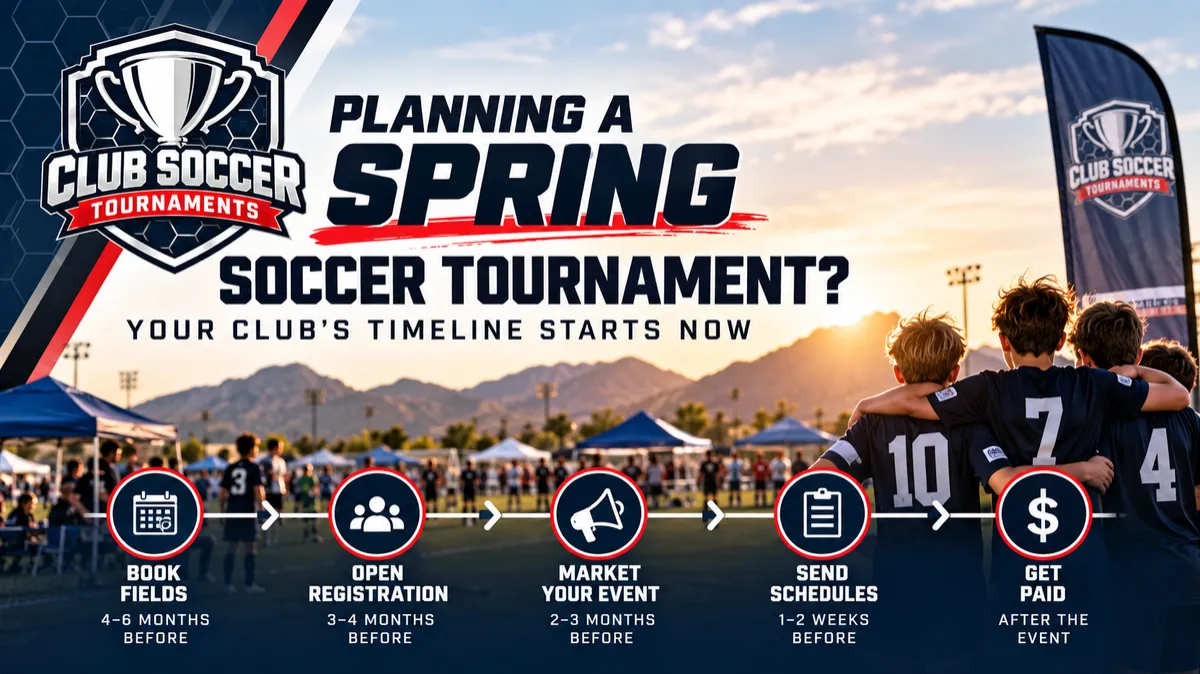
The Club Director's Dilemma: Every soccer club wants the $10,000 to $25,000+ in annual fundraising revenue that a home tournament provides—and every coach loves giving their players a home-field championship weekend. The reason 70% of clubs don't host one (or quit after year two) comes down to two words: volunteer burnout. Here is how modern turnkey and co-managed tournament partnerships solve the operational grind.
If you ask a club president or Director of Coaching what happened to the tournament their club used to run five years ago, you will almost always hear the same story: "We had one incredible board member who ran the whole thing out of a binder. When their kid graduated, nobody else had 250 free hours to take it over."
Running a youth soccer tournament from scratch ("DIY") is not just a weekend commitment—it is a four-month part-time job involving outreach to hundreds of coaches, sanctioning paperwork, GotSport or Exposure bracket configuration, referee assignor negotiations, coach schedule requests, weather contingency plans, and 6:00 AM field setup.
Today, youth soccer clubs no longer have to choose between burning out their board or leaving $15,000+ on the table. By partnering with a dedicated tournament operations team like Club Soccer Tournaments (CST), clubs can hand off anywhere from 50% to 100% of the operational workload while keeping their club's name, branding, and fundraising profit front and center.
1. Where Do the 240+ Hours of Tournament Work Actually Go?
Before comparing DIY vs. Turnkey management, it helps to audit the actual hours required to execute a 60-to-80 team weekend youth soccer tournament properly:
- Outreach, Marketing & Coach Follow-Up (70–90 Hours): Building a website page, designing flyers, running social campaigns, scraping regional club directories, emailing and calling 1,500+ coaches, and answering pre-registration questions about divisions and multi-team discounts.
- Registration Desk, Rosters & Check-In (35–45 Hours): Chasing unpaid team invoices, verifying player birth dates/waivers/passcards, processing late additions, and handling online check-in the week of the event.
- Division Flighting & Conflict-Free Scheduling (30–40 Hours): Grouping teams into balanced 4-, 6-, or 8-team flights, de-conflicting coaches who coach two or three teams, honoring travel-distance requests for Friday night/Saturday morning kickoffs, and assigning fields by size (7v7, 9v9, 11v11).
- Referee, Trainer & Vendor Logistics (25–35 Hours): Coordinating with certified referee assignors, ordering medals/trophies/banners, booking certified athletic trainers, arranging portable restrooms, and managing food trucks.
- Weekend Tournament HQ & Live Scoring (40–50 Hours across Staff): Field setup, referee check-in and game-card collection, live bracket standings updates, weather/lightning protocol management, and championship medal ceremonies.
2. Side-by-Side Comparison: DIY Club Committee vs. CST Turnkey Partnership
How does a volunteer-run DIY tournament compare to partnering with Club Soccer Tournaments, backed by 26 years of national event execution?
| Operational Category | DIY Volunteer Committee | CST Turnkey / Co-Managed Partnership |
|---|---|---|
| Club Board & DOC Time Commitment | 200–260+ hours over 4 months; high stress during the 14 days prior to kickoff. | 5–15 hours total (approve dates, secure fields, rally internal teams). |
| Visiting Team Recruitment | Relies on state list, local emails, and personal favors; average 35–55 teams. | Multi-state database + paid Meta/Google ads + dedicated phone/SMS outreach team; typically adds 25–60+ extra teams. |
| Coach & Team Customer Service | DOC or volunteer answers texts and emails late at night after their day job. | Dedicated CST support team handles all coach questions, invoices, and roster help Mon–Sun. |
| Scheduling & Coach De-Confliction | Manual spreadsheet or first-time software headaches; frequent Friday-night schedule rebuilds. | Pro scheduling team builds conflict-free brackets with coaching & travel constraints baked in. |
| Upfront Financial Risk to Club | Club fronts $5,000–$12,000+ for medals, software, trainers, and ads before fees arrive. | $0 upfront risk in Turnkey tier—expenses are paid directly out of tournament revenues. |
| Game-Day Execution | Board members miss watching their own kids play because they are stuck at the HQ tent. | Experienced CST Tournament Director runs HQ, scoring, and medal presentations. |
3. Why Turnkey Tournaments Often Net MORE Money for the Club Than DIY
A common misconception among club treasurers is: "If we partner with an outside tournament management company, won't their fee reduce our club's profit?"
In practice, the opposite happens for three reasons:
- Higher Team Counts Drive Exponential Margin: Because CST actively markets your event to thousands of coaches across neighboring states via phone, SMS, email, and paid ads, a tournament that might attract 42 teams on its own routinely grows to 70 to 95+ teams. Those 30–50 additional teams generate $19,000 to $32,000+ in incremental gross revenue—more than covering CST's operational share while increasing the club's net check.
- National Buying Power on Medals, Software & Vendors: Because our organization runs hundreds of soccer events nationwide, we procure custom medals, championship banners, insurance, and marketing impressions at volume rates a single once-a-year tournament cannot match.
- Your Club Keeps 100% of Local Add-On Streams (Or Shares Zero Risk): When your club volunteers aren't buried in scheduling spreadsheets and referee assignments, they can spend 10 hours selling 5 local field sponsorships ($3,500) and lining up 4 food trucks ($1,500)—putting an effortless $5,000 straight into the club bank account on top of your registration payout.
Not ready to hand over 100% of the event? That's why we built 4 flexible partnership tiers. You can hire CST strictly for Tier 1 (Marketing & Team Recruitment) or Tier 2 (Marketing + Registration & Scheduling) while keeping game-day operations in-house. Compare all 4 packages here →
4. What a Turnkey Hosting Timeline Looks Like for Your Club
When your club partners with Club Soccer Tournaments, we condense the entire launch process into four simple milestones (see our full 16-Week Tournament Planning Timeline for week-by-week details):
- Step 1 — 20-Minute Strategy Call: You meet with Travis Tew and Andrew Vorce to review your facility capacity, select your ideal 2027 weekend, and pick the partnership tier that fits your board.
- Step 2 — Branded Launch Within 7 Days: We launch your tournament registration page, configure early-bird pricing, and begin multi-channel outreach to regional clubs and coaches.
- Step 3 — Weekly Registration & Revenue Updates: Your board receives clear progress updates as divisions fill, while our staff handles coach questions, referee assignors, and bracket building.
- Step 4 — Kickoff Weekend & Fast Payout: Teams enjoy a crisp, professionally run tournament on your fields, and your club receives its full accounting reconciliation and net revenue payout right after the final whistle.
Frequently Asked Questions: Turnkey vs. DIY Hosting
Does the tournament still carry our soccer club's name and logo?
Yes! It is your club's tournament (e.g., "The [Your Club Name] Spring Classic" or "[Your Club] Cup"). We operate as your behind-the-scenes engine so your club builds long-term brand prestige in your region.
What if our club already has a local referee assignor we love working with?
Awesome—we always prioritize your trusted local referee assignor and local athletic trainers first, and our team handles the game counts, schedule exports, and payment logistics with them so you don't have to chase paperwork.
Can we start with a 1-day tournament before committing to a full 2-day weekend event?
Absolutely. Many partner clubs launch with a high-energy one-day tournament to test their complex and generate $5,000–$10,000+ in net profit in a single day, then expand to a full two-day 7v7/9v9/11v11 invitational the following season.
